Solutions

Every counterparty checked, and every decision on the record.

NethuneX checks the ships, companies and owners you deal with against the published sanctions lists of the United States, the United Kingdom, the United Nations, the European Union and Australia, checks them again every night, and keeps each screening with the lists it ran against.

The problem

A new name on the fixture, and lists that change every week.

A broker offers a cargo, a supplier quotes a stem, a ship is proposed for a charter. Someone looks the name up on a government website, if they remember to. When a bank, a charterer or an auditor later asks what was checked, against which list and on what date, the answer is a screenshot, or nothing.

What the office asks
  • Is this ship, or anyone who owns it, on a list?
  • Has anyone we cleared last month been listed since?
  • Do listed owners hold half of this company between them?
  • What did we check, when, and who made the call?
How NethuneX handles it

One desk for the lists, the matches and the decisions.

Sanctions Screening keeps the lists, the watch list of everyone you deal with, the open cases and the register of every screening behind six tabs.

Sanctions Screening › Screen

Ships by IMO number, companies by name

An IMO number that matches a listed ship is the same ship, never a coincidence. Names are compared with legal suffixes and punctuation removed, against every other name the list gives, and each candidate is banded strong, probable or possible. The band says how close the match is, not how likely the subject is to be sanctioned.
Sanctions Screening › Subjects

Everyone you deal with, re-checked overnight

Every vessel in the fleet, every contact in the directory and every party in an ownership chain is on the watch list without anyone adding it. Each night, after the lists are refreshed, all of them are screened again, and only a change is recorded: a new match, a changed band, or a subject you cleared that now matches.

Sanctions Screening › Cases and Register

Decisions that cannot be edited later

A match opens one case per subject, aged from the first screening that found it, so a re-check does not reset the clock. Clearing, escalating or blocking needs a reason. Screenings and decisions are written once and never changed, each with a snapshot of the lists it ran against, and any one of them prints as an evidence pack.

Sanctions Screening › Subjects › Ownership

The 50 % rule, followed down the chain

Owners, managers and parent companies are recorded against each vessel, nested as deep as the chain goes, and each is screened in its own right. Listed shares are added up under OFAC’s 50 Percent Rule. A share nobody has recorded is reported as not quantified, never as zero.

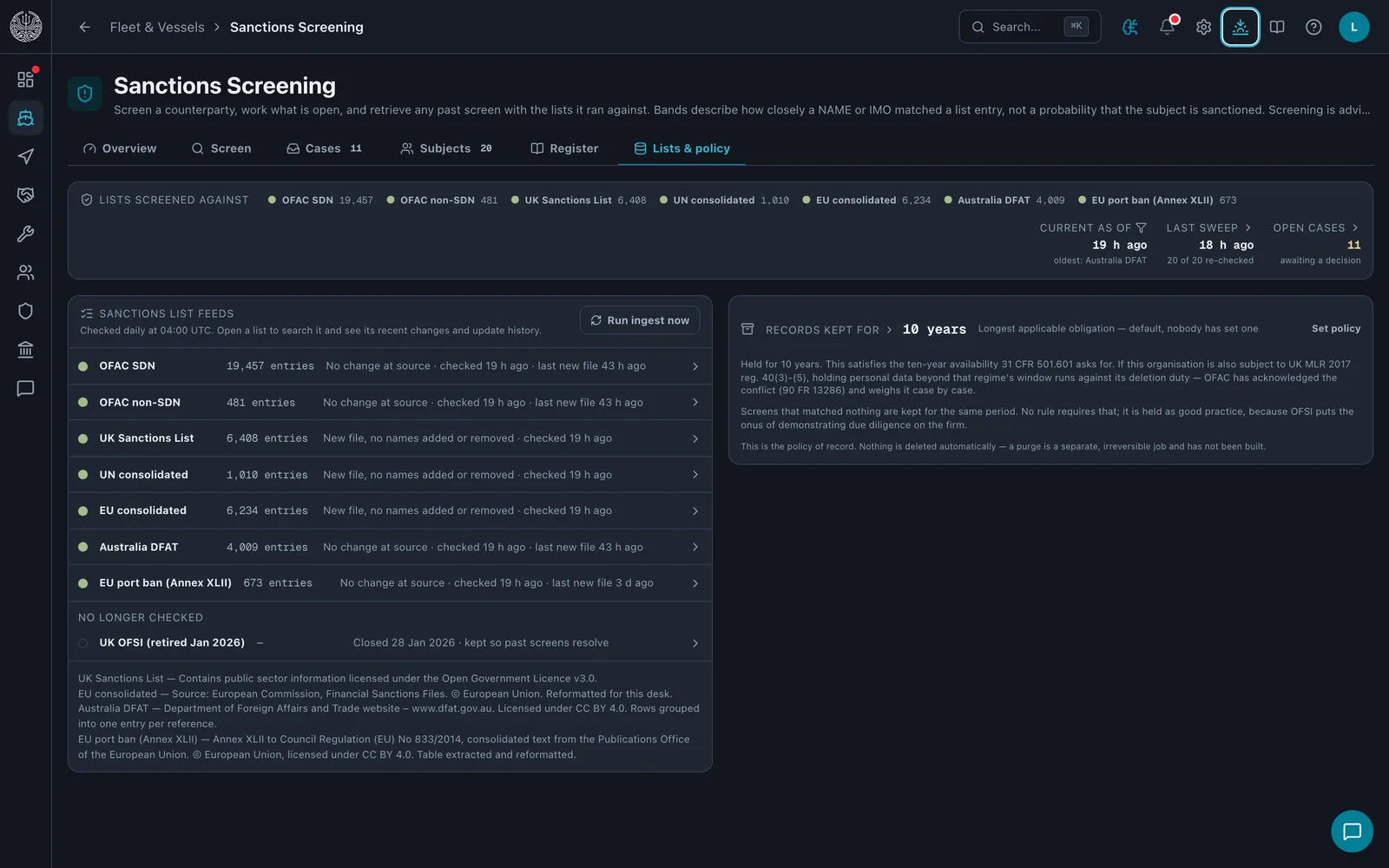
The Sanctions Screening desk on its Lists and policy tab: a strip of the seven lists screened against with their entry counts, a sanctions list feeds card showing when each list was last checked and whether its file changed, a retired UK OFSI list kept for past screenings, and a records-kept-for card set to ten years.
Sanctions Screening › Lists & policyThe seven lists held, each checked daily at 04:00 UTC with its entry count and the date on the publisher's file, and the record-keeping policy in force.

The lists, straight from the publishers

Each list is downloaded from its publisher every day, and a list that has not changed is not rewritten. Open any one to search it, see what was added or removed, and read its update history.

  • OFAC SDN
  • OFAC non-SDN (Consolidated)
  • UK Sanctions List
  • UN Security Council Consolidated List
  • EU consolidated financial sanctions
  • Australia DFAT Consolidated List
  • EU port-access ban (Annex XLII)

A check where money or a contract moves

Before a charter party, a bunker or spares award, a purchase order or a payment goes ahead, the counterparty’s screening state is shown. If it was never screened, was screened too long ago, has a match nobody has decided, or was blocked, the user acknowledges that before going on. The check warns and records who went ahead; it does not stop the deal.

Rules and standards

What it helps you keep to.

United States (OFAC)IEEPA · TWEA · 31 CFR chapter V
The SDN and non-SDN lists, the 50 Percent Rule applied down an ownership chain, and screenings kept for the ten years 31 CFR 501.601 asks for.
United KingdomSanctions and Anti-Money Laundering Act 2018
The UK Sanctions List, other names included, and an ownership-and-control indicator for listed parties.
European UnionArt. 215 TFEU · Council Regulation (EU) No 833/2014, Annex XLII
The consolidated financial sanctions list, and the vessels banned from EU ports under Annex XLII.
United NationsUN Charter, Chapter VII, Article 41
The Security Council Consolidated List.
AustraliaAutonomous Sanctions Act 2011
The DFAT Consolidated List.

Screening is advisory: the listing authority’s published record is definitive. Sanctions Screening is an add-on module.

Related modules
  • Voyage & port operations

    Voyage P&L, port calls and disbursements, laytime and demurrage, live AIS tracking, weather routing.

    On the platform page

  • Bunkers

    Enquiries to your suppliers, quote comparison, fuel burn-down, consumption tracking.

    On the platform page

  • Planned maintenance

    Maintenance schedules, defect reporting, spares and procurement, drydock planning.

    On the platform page

See who you are trading with.

A call about the counterparties and trades you handle, then a walk through the screening desk on the demonstration organisation.