Solutions

The carbon position of every ship, voyage by voyage.

A ship of 5,000 GT or more now owes EU allowances for the carbon it emits reaching an EEA port, reports the intensity of its fuel under FuelEU Maritime, and from July 2026 owes UK allowances on a UK-domestic voyage. NethuneX computes each position per voyage leg and checks it against the noon reports the crew already writes.

347 daysto the EU ETS surrender for 2026, due 30 September 2027

€2,400FuelEU penalty per tonne of VLSFO-equivalent deficit

100 % owedof in-scope EU ETS emissions for 2026, under the directive's phase-in

The problem

Four regimes, four deadlines, one set of fuel figures.

CII, EU ETS, FuelEU and now UK ETS all start from the same facts: fuel burned by grade and distance sailed. In most offices each one is worked out in its own spreadsheet, from figures typed in again, and the copies drift apart before a verifier sees them.

What the office asks
  • How many allowances do we owe for this year, and by when?
  • Is pooling cheaper than paying the FuelEU penalty?
  • Which of our ships rate D or E this year?
  • Do the noon reports and the MRV figures agree?
How NethuneX handles it

CII

IMO MEPC.353(78) · MEPC.354(78) · MEPC.355(78) · MEPC 83 (2025)

What the rule demands

Each ship gets an annual carbon-intensity rating from A to E. The attained figure is the year’s CO₂ in grams divided by the ship’s capacity, deadweight tonnes for cargo ships and gross tonnage for ro-ro and passenger ships, times nautical miles sailed.

The required figure is the ship type’s reference line cut by the year’s reduction factor, 11 % for 2026 and rising each year to 21.5 % in 2030. The rating comes from how far the attained sits from the required, on boundaries set per ship type.
What the CII Dashboard computes

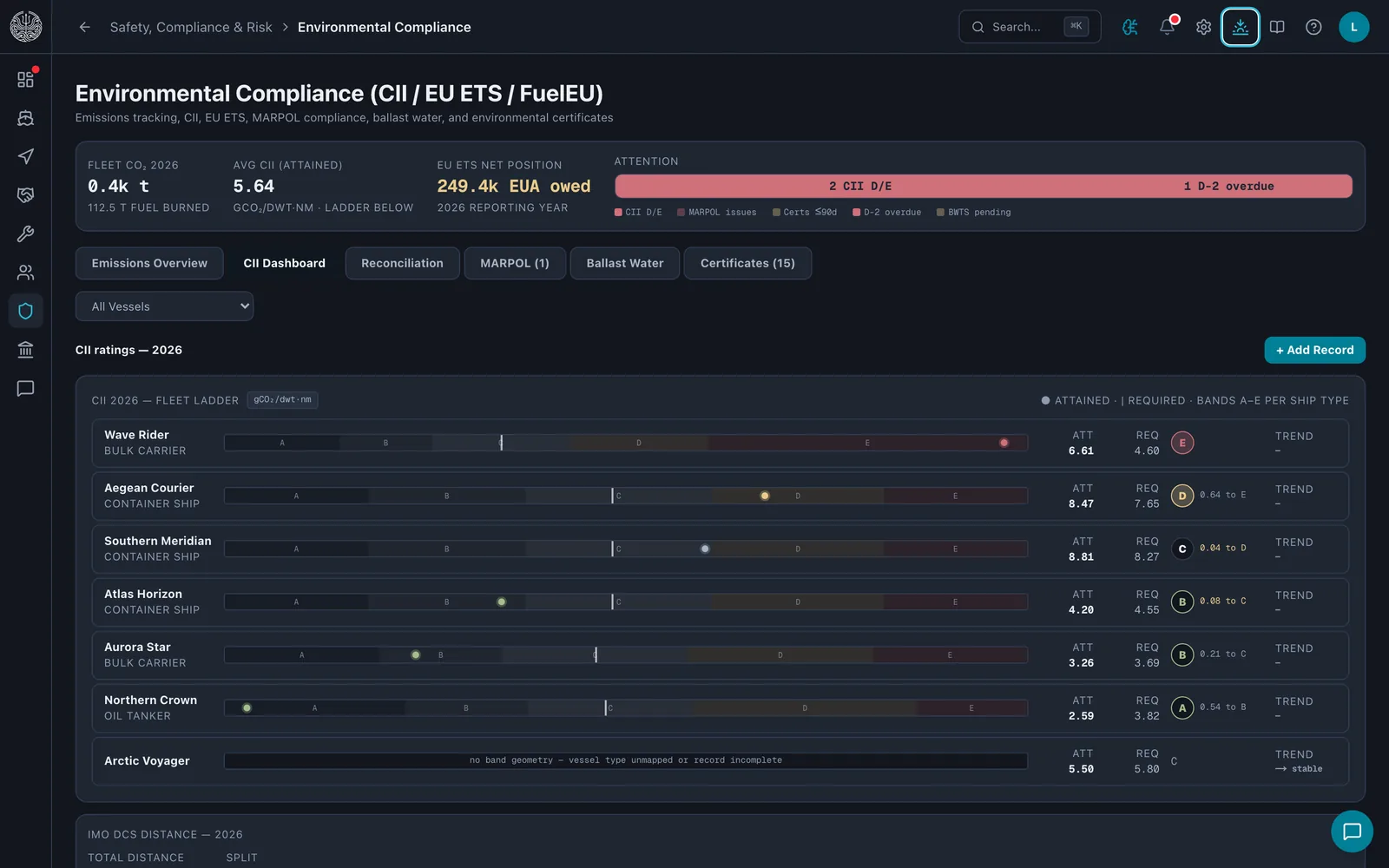
The fleet sits on one ladder, each vessel’s attained figure set against its required line with the A to E band edges for its ship type. The attained figure is recomputed from the vessel’s own noon reports, fuel by grade and distance sailed, and a chip flags an entered figure that drifts from it.

Beneath the ladder, the IMO DCS card totals the year’s distance from the same reports.

The CII dashboard: a fleet ladder for 2026 with seven vessel rows, each showing an attained marker against a required marker on an A-to-E band track, rated from A to E; and an IMO DCS distance card of 274,060 nautical miles from 723 noon reports.
CIIThe 2026 ladder on the demonstration fleet: each vessel's attained figure set against its required line on the A–E band track for its ship type, and the IMO DCS distance card, 274,060 nm from 723 noon reports.

EU ETS

Directive 2003/87/EC · as amended by (EU) 2023/959

What the rule demands

A voyage between two EEA ports is in scope for all of its emissions. A voyage between an EEA port and one outside is in scope for half. A voyage between two non-EEA ports is out of scope.

The obligation was phased in, 40 % of in-scope emissions for 2024, 70 % for 2025 and 100 % from 2026. From 2026 methane and nitrous oxide count alongside carbon dioxide. Allowances for a reporting year are surrendered by 30 September of the following year.

What the EU ETS screen computes

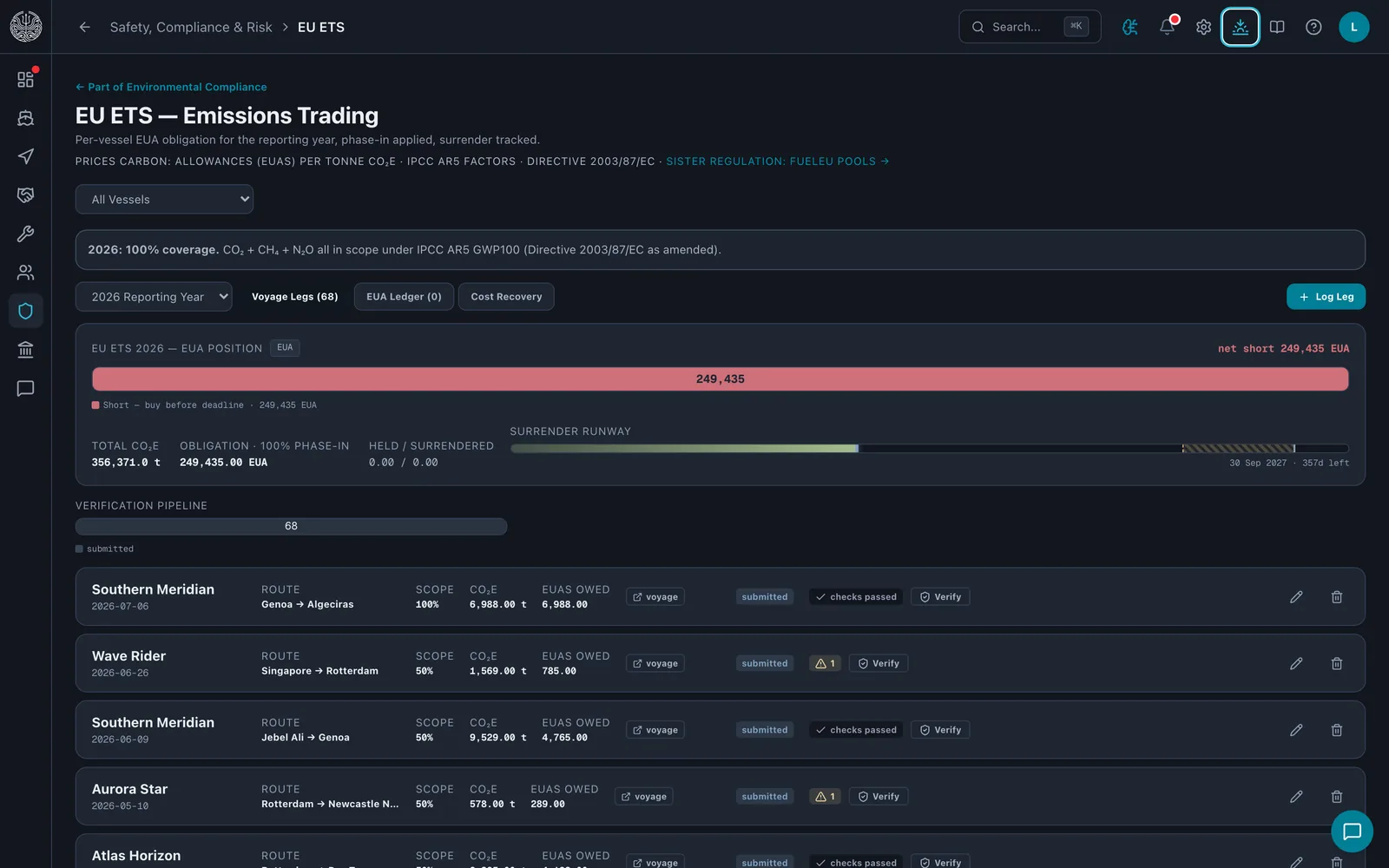
Each voyage leg, load port, discharge port and fuel burned by grade, is stored with its three multipliers kept separate (tonnes of CO₂-equivalent, scope share, phase-in share), so a verifier can reproduce the allowance figure without reading code.

The year’s position runs as one bar, surrendered, covered by holdings and short, over a runway to the surrender deadline. Each leg moves through draft, submitted, verified and surrendered.

The EU ETS module: a net-short position bar of 249,435 allowances, total CO2-equivalent of 356,371 tonnes, a surrender runway to 30 September 2027, a verification pipeline, and voyage legs with scope, emissions and allowances owed.
EU ETSEU ETS 2026 on the demonstration fleet: net short 249,435 EUA, 356,371 t CO₂e, the runway to 30 September 2027, and the legs beneath.

FuelEU Maritime

Regulation (EU) 2023/1805

What the rule demands

The greenhouse-gas intensity of the energy a ship uses, well-to-wake in grams of CO₂-equivalent per megajoule, must sit under a target that steps down from the 2020 baseline of 91.16, by 2 % from 2025, 6 % from 2030, 14.5 % from 2035, and on to 80 % from 2050.

A ship above the line carries a compliance deficit and pays €2,400 per tonne of VLSFO-equivalent energy, 10 % more for every consecutive year it misses. Article 20 lets a surplus be banked or a limited advance borrowed from the next year. Article 21 lets ships pool their balances, and the pool complies if its sum is at or above zero.

What FuelEU Pools computes

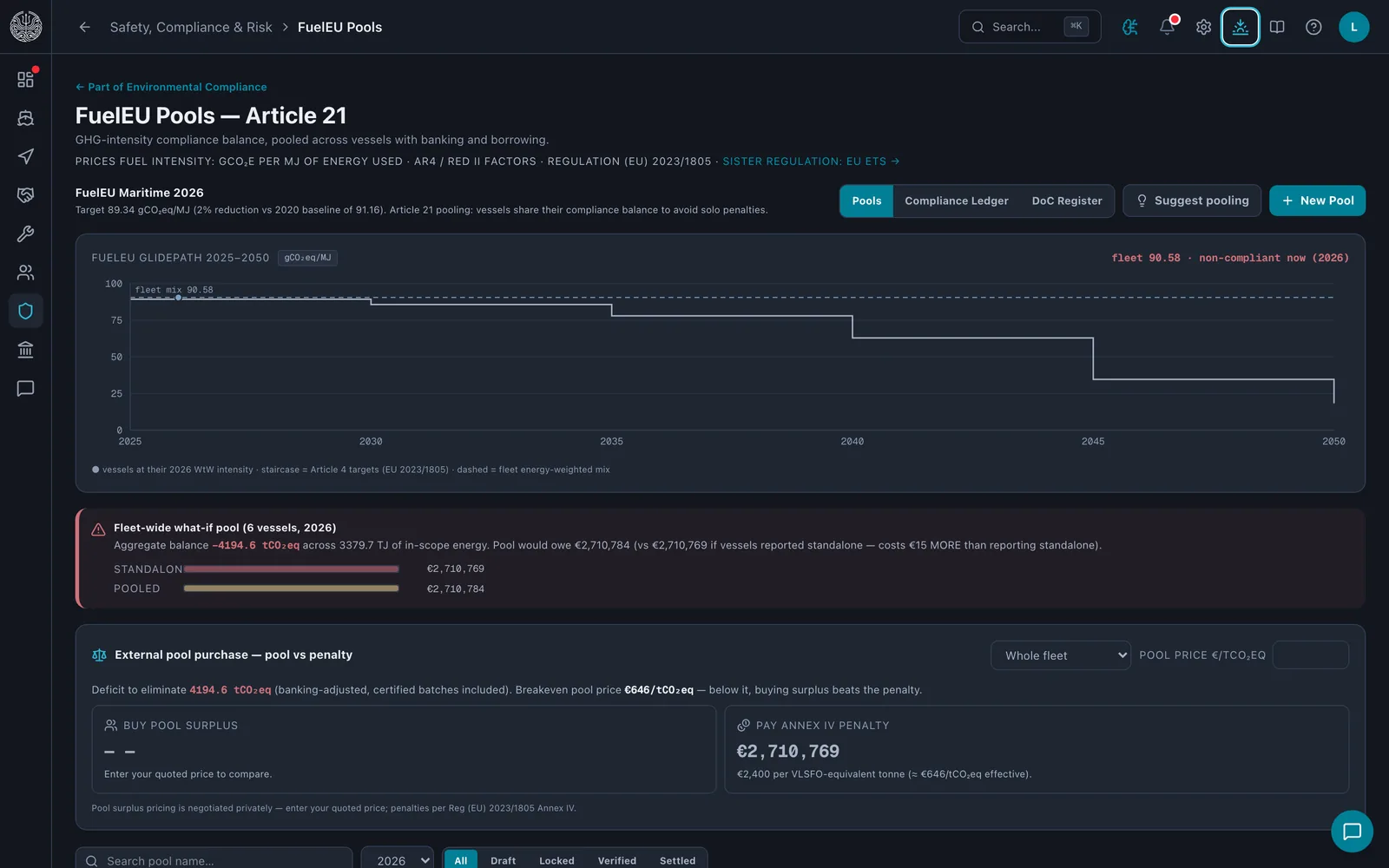
Each vessel’s energy-weighted intensity is computed from its in-scope fuel by grade, with verified certified batches blended in at their own intensity, and set against the year’s target to give a compliance balance in grams of CO₂-equivalent.

The glidepath draws the Article 4 staircase from 2025 to 2050 with the fleet’s mix as a line across it, so the crossing year reads directly. The pool desk aggregates balances under Article 21, prices a deficit against the penalty or a quoted external pool price, and an optimiser searches for the cheapest valid pool membership and says when its answer is a heuristic.

The FuelEU Pools module: a greenhouse-gas intensity glidepath from 2025 to 2050 with the fleet mix as a dashed line, a fleet-wide what-if pool showing pooled and standalone cost, and an external pool purchase panel set against an Annex IV penalty of 2,710,769 euros.
FuelEU PoolsArticle 21 pooling on the demonstration fleet: the 2025–2050 glidepath, a fleet-wide what-if pool, and an external pool purchase set against a €2,710,769 penalty.

UK ETS

gov.uk · UK ETS for maritime: how to comply · 22 Jun 2026

What the rule demands

The UK scheme is separate from the EU one and reaches UK-domestic voyages only. A voyage between two UK ports is in scope for all of its emissions; an international voyage, including one to the EEA, is out of scope. Carbon dioxide, methane and nitrous oxide count from the first day.

Voyages between Northern Ireland and Great Britain are reported in full but surrendered at half. The scheme’s dates are listed beneath.

What NethuneX computes

The obligation in UK allowances is computed from the same voyage legs as EU ETS and shown beside the EU ETS position whenever a year has UK-domestic legs. Holdings of UK allowances are not yet tracked. Each leg’s ports are matched to the seeded port list; UK-domestic legs are kept; 2026 legs that start before 1 July are counted as outside the first scheme year; and legs whose ports do not resolve are counted as unresolved rather than guessed in or out.

One thing the legs model does not yet capture is emissions at berth, which the scheme also covers. The screen says so.

In force
1 July 2026
First scheme year
1 July to 31 December 2026
From 2027
calendar years
First surrender
30 April 2028, for 2026 and 2027
Thereafter
30 April of the following year
Checks around the positions

Before the statement, and before the fixture.

Environmental Compliance › Reconciliation

Two sources, one answer

CII reads the noon reports; EU ETS and FuelEU read the MRV voyage dataset. The reconciliation view sets fuel, distance and CO₂ from the two side by side per vessel and year, flags any gap beyond tolerance, and exports the comparison as a CSV for the verifier.

Vessel Screening

Carbon cost before you fix

For one cargo, the simulator ranks your own ships by daily earnings with the ballast leg included. Each carries an EU ETS cost, a FuelEU penalty line and the direction it moves the CII rating, and a toggle decides whether the charter passes those costs through under BIMCO’s ETS (2022) and FuelEU (2024) clauses.

Factors

Two factor sets, never mixed.

EU ETS and FuelEU weigh methane and nitrous oxide differently. EU ETS uses the 100-year warming potentials of the IPCC Fifth Assessment Report; FuelEU Maritime refers to the Renewable Energy Directive’s older Fourth Assessment Report values. The same voyage therefore gives two different CO₂-equivalent figures, and each is right in its own regime. The emissions engine takes the regime as an argument and returns the figure tagged with it, so one report cannot mix them.

RegimeFactor setCO₂CH₄N₂O
EU ETSIPCC AR5128265
FuelEU MaritimeIPCC AR4 / RED II125298

GWP100 weights per tonne of gas, read from the engine’s constants.

Rules and standards

What it helps you keep to.

IMO CIIMEPC.353(78) · MEPC.354(78) · MEPC.355(78)
Attained figure recomputed from the noon reports and set against the required line and the A to E boundaries for the ship type.
IMO DCSMARPOL Annex VI, Appendix IX
The year's distance totalled from the same noon reports, with the 2027 reporting changes noted on the card.
EU ETSDirective 2003/87/EC, as amended by (EU) 2023/959
Allowances owed per voyage leg, with scope and phase-in kept as separate multipliers, and the year's position against the surrender date.
EU MRVRegulation (EU) 2015/757, as amended by (EU) 2023/957
The voyage-leg dataset EU ETS and FuelEU are computed from, checked against the noon reports before a statement goes out.
FuelEU MaritimeRegulation (EU) 2023/1805
Well-to-wake intensity and compliance balance per vessel, the penalty for a deficit, banking and borrowing, and Article 21 pooling.
UK ETSgov.uk · UK ETS for maritime: how to comply
The obligation in UK allowances for UK-domestic legs, shown beside the EU ETS position.
Related modules
  • Emissions & EU regulation

    CII ladder, EU ETS position, FuelEU pooling, UK ETS, MRV reporting.

    On the platform page

  • Bunkers

    Enquiries to your suppliers, quote comparison, fuel burn-down, consumption tracking.

    On the platform page

  • Voyage & port operations

    Voyage P&L, port calls and disbursements, laytime and demurrage, live AIS tracking, weather routing.

    On the platform page

Bring the fleet aboard before the deadline does.

A call about the vessels and the ports they call at, then a walk through the four positions on the demonstration fleet.