Solutions

Ready for the inspector before the ship reaches port.

Rest hours, certificates, crew medicals, findings and inspections, kept in the registers a Port State Control officer, a vetting inspector or an auditor asks for, and checked against the rules that set them.

The problem

Every deadline lives somewhere different. The inspector asks for all of them at once.

Rest-hour sheets are on board, certificate dates are in a spreadsheet, findings are in an email thread and a medical expiry is in a seafarer’s folder. Each one works until an officer asks for them together, and something has lapsed that nobody was watching.

What the office asks
  • Which certificates expire before the next port?
  • Who on board cannot legally sail today?
  • Is anyone short of rest, or are the records too tidy to be true?
  • Which findings are still open, and for how long?
How NethuneX handles it

One list per question, across the fleet.

Vessel Certificates

Nothing expires unseen

Statutory, class, flag-state, crew and insurance certificates run to their recorded expiry dates in the 90, 60 and 30-day windows, worst first. Inside 30 days a certificate reads as a Port State Control detention risk. An existing list imports from a spreadsheet.

Certificates & Medical

Who can legally sail today

Each seafarer’s medical fitness, STCW certificates and flag endorsements are read against their expiry dates, so a lapsed medical or certificate shows before the crew change. A matrix sets each rank against the STCW certificates it normally needs.

Audits & Findings · PSC Inspections · Vetting Inspections

Findings closed, not filed

Every finding, from a major non-conformity down to an observation, carries its corrective action and its age until it closes. Port State Control inspections keep their deficiencies and detentions, and SIRE 2.0, CDI and RightShip inspections run on a 12-month acceptance clock.

The Vessel Certificates module: an expiry pressure bar, and a runway per certificate running to its expiry date, with an EXPIRED chip and the days overdue on each lapsed one.
Vessel CertificatesExpiry pressure across the fleet, and a runway for every certificate to its recorded expiry date.

Rest hours

MLC 2006 · Standard A2.3 · STCW A-VIII/1

What the rule demands

A seafarer must have at least 10 hours of rest in any 24-hour period and at least 77 hours in any 7-day period. The rest may be split into no more than two periods, one of them at least 6 hours long, and the gap between consecutive rest periods may not exceed 14 hours.

Records are kept daily.

What Work & Rest computes

The engine rebuilds each seafarer’s rest timeline at half-hour resolution. The hour floors and the 14-hour cap are checked over every rolling window; the two division rules are checked per record day, the way the IMO/ILO table is read, so a sleep that crosses midnight is one period. Any breach grades the seafarer red; within half an hour of a daily limit, or an hour of the weekly floor, amber.

The office desk never edits a ship-submitted record. Its signature instrument sets violations found on one side against the implausibility of the record on the other, since a log that hits the legal minimum every day is itself flagged for review.

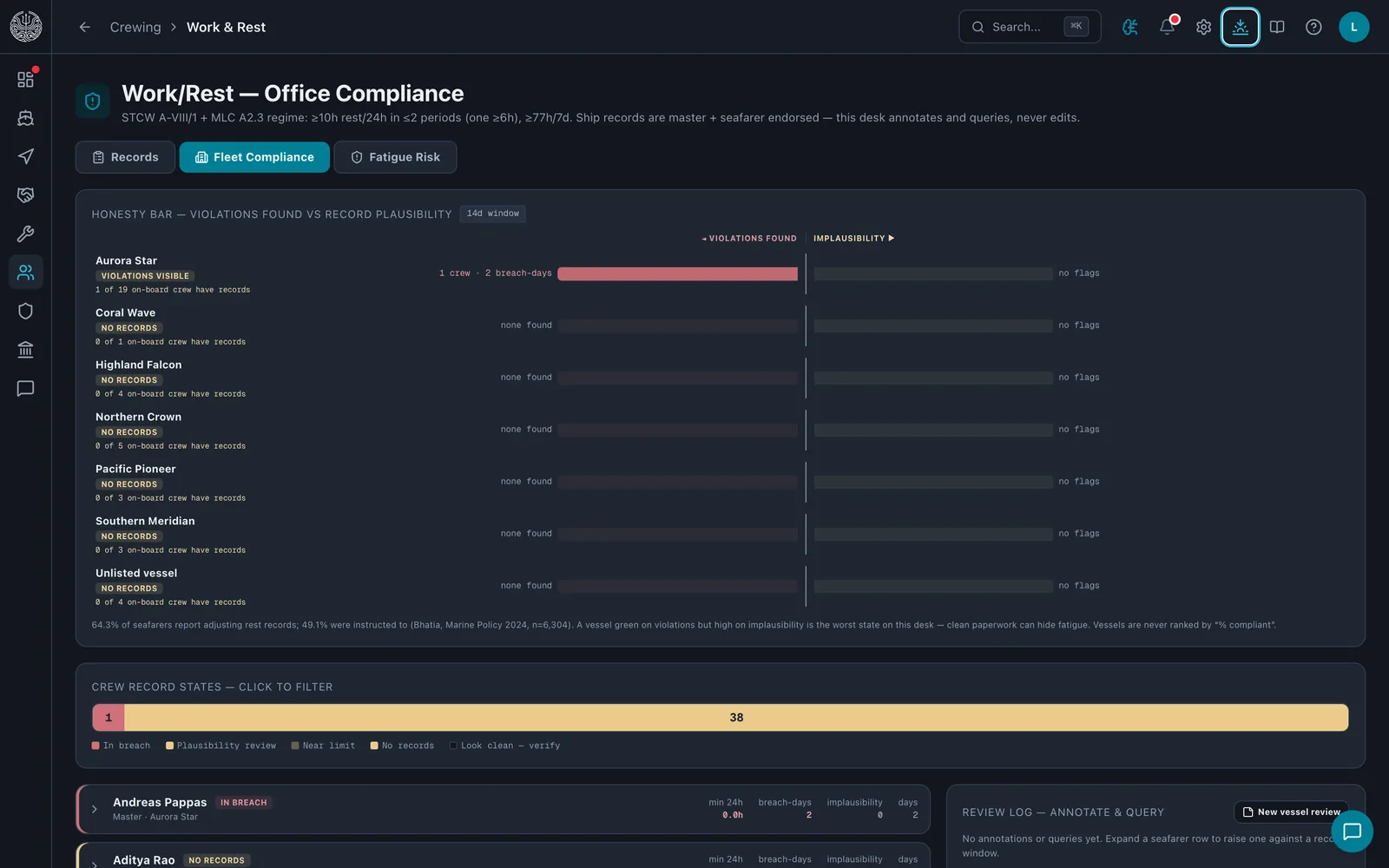
The work-and-rest office desk: an honesty bar per vessel with violations found on one side and record implausibility on the other, crew record states, and a review log.
Work / RestThe office desk: the honesty bar per vessel, crew record states and the review log.
Also on the same record
  • Drills & Work Permits

    A drill matrix per vessel marks each drill compliant, due soon, overdue or never done, against the SOLAS, ISPS and MARPOL intervals.

  • Class Surveys

    Annual, intermediate and special survey windows worked out from the dates you record, per IACS UR Z7.

  • Crew Payroll

    Each vessel month by month, so a month with no pay run shows as a gap against MLC Standard A2.2.

  • Compliance Calendar

    Certificates, maintenance, drills, audit findings and demurrage time bars on one timeline.

Rules and standards

What it helps you keep to.

Hours of restMLC 2006 Standard A2.3 · STCW A-VIII/1
Every record checked: the hour floors and the 14-hour gap over rolling windows, and the two division rules per record day.
Seafarer certification and medicalsSTCW Reg. I/2 · Reg. I/9 · MLC 2006 Standard A1.2
Medical certificates, certificates of competency and flag endorsements per seafarer, against their expiry dates.
WagesMLC 2006 Standard A2.2
Pay runs per vessel per month, with a missing month shown as a gap.
Non-conformities and corrective actionISM Code, section 9
Findings from a major non-conformity to an observation, each with its corrective action and its age until closed.
Port State ControlParis MoU · Tokyo MoU
Inspections, deficiencies and detentions recorded per vessel, and the fleet's own detention rate read against the published averages as a reference.
DrillsSOLAS Reg. III/19 · ISPS Code Part A · MARPOL Annex I Reg. 37
The interval for each drill type, and the date each vessel last ran it.
Related modules
  • Crew & compliance

    Certificates and expiries, MLC work and rest hours, rotations and payroll.

    On the platform page

  • Safety & audits

    Incidents and near misses, drills and permits, PSC and SIRE preparation, safety documents.

    On the platform page

Walk aboard ready.

A call about the fleet, its flags and the inspections it faces, then a walk through the registers on the demonstration fleet.