Solutions

Keep every ship in class and working.

Planned jobs, equipment, defects and spares on one register per vessel, with the fleet view the office needs over the top, and purchasing that checks the invoice against what was ordered and received.

The problem

A job missed on board becomes a finding ashore.

The maintenance system on board, the defect list in an email, the spares count in a spreadsheet and the superintendent’s own notes rarely agree. Often the first sign of a missed job is a surveyor or a Port State Control officer finding it.

What the office asks
  • Which jobs are overdue, by date or by running hours?
  • Which defects have been open longest, and how serious are they?
  • Are the critical spares actually on board?
  • Does this invoice match what we ordered and received?
How NethuneX handles it

One register per vessel, one view across the fleet.

Planned Maintenance

Due by the calendar or by the hours

Jobs run on a calendar interval or on running hours, with a grace period and the vessel’s own local date deciding when one is overdue. A template applies to the equipment you choose on any vessel, one work order per unit. Deferring or cancelling needs a reason, closing needs a sign-off, and every change is kept in the job’s history.
Equipment Register

Every unit, its hours and its sticker

Equipment sits in a tree per vessel, critical units marked, with hours since overhaul against the interval and a reading gone stale flagged. The register prints QR stickers, 21 to an A4 sheet; scanning one from the crew’s defect form attaches that unit to the report.

Defects & Repairs

From the crew's phone to a work order

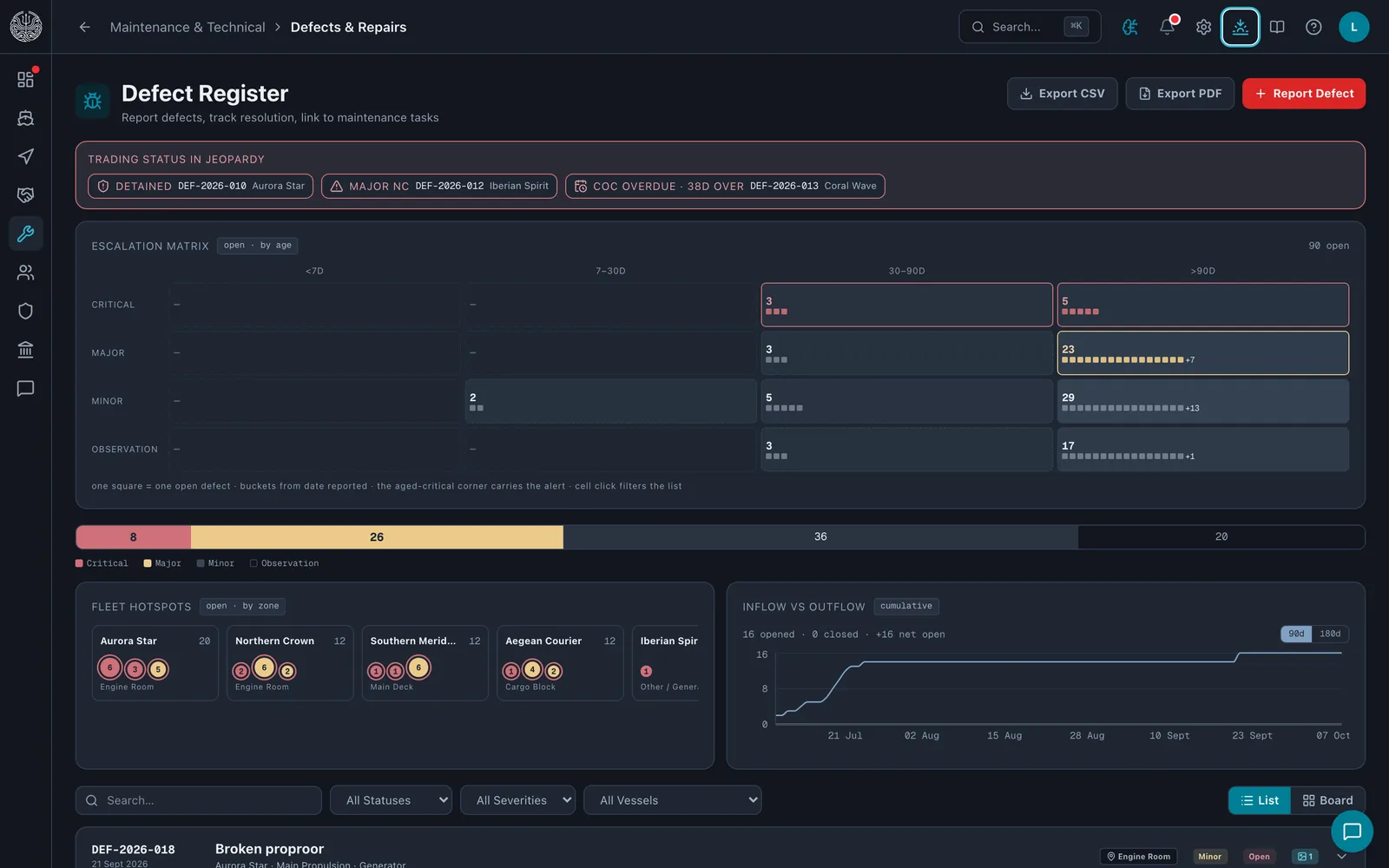
The crew raise a defect from the phone with up to six photos; with no signal it is kept on the phone and sent once the app is back online. Open defects sit on a severity-by-age matrix, Critical to Observation against under 7 days to over 90. One step turns a defect into a corrective work order, and a deferral records its risk assessment and who authorised it.

Spares & Inventory · Procurement

Spares ordered, received and matched

A part below its reorder point becomes a draft requisition, approved by master, superintendent and purchasing according to its value. Deliveries are received against the order, and each invoice is matched to the order and the receipt line by line; an invoice that fails the match cannot be approved.

The Defect Register: a strip of vessels whose trading status is in jeopardy, an escalation matrix of severity against age, fleet hotspots per vessel, and a chart of defect inflow against outflow.
Defects & RepairsOpen defects by severity and age, the vessels they concentrate on, and defects opened against defects closed over the window.
Also on the same record
  • Dry Dock & Projects

    A 24-month docking window per vessel, budget against actual, and a candidate scope drawn from deferred defects.

  • Lube-Oil Analysis

    Lab results checked against published limit profiles, with the lab's own verdict shown beside, never merged.

  • Hull Condition

    Tank coating condition drawn on the ship, and a speed-loss estimate from noon reports with cleanings marked.

  • Service Letters

    Makers' letters with their urgency, and whether each applies to each vessel and is done.

Rules and standards

What it helps you keep to.

Maintenance of the ship and equipmentISM Code, section 10
Planned jobs signed off when done, a reason for every deferral, critical equipment marked under 10.3, and a history of every status change.
Class survey cycleIACS UR Z7 · class CMS schemes
Survey windows and continuous-survey due dates worked out from the dates you record.
Critical sparesOCIMF SIRE 2.0
Critical spares on board against the minimum each item needs, with any shortfall and its expected delivery.
Lube-oil conditionCIMAC Recommendations 29/30 · IACS UR Z21
Results flagged against the cited limits; an oil with no published standard gets no profile, and the screen says so.
Hull performanceISO 19030-3 (aligned)
A speed-loss proxy from noon-report data, not from high-frequency sensors.
Related modules
  • Planned maintenance

    Maintenance schedules, defect reporting, spares and procurement, drydock planning.

    On the platform page

  • Safety & audits

    Incidents and near misses, drills and permits, PSC and SIRE preparation, safety documents.

    On the platform page

See the fleet's maintenance in one place.

A call about the vessels and how maintenance runs today, then a walk through the registers on the demonstration fleet.